





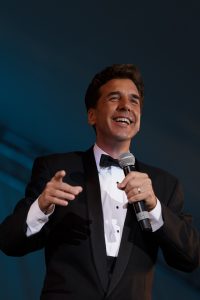
Today we’d like to introduce you to Michael Andrew.
Hi Michael, thanks for sharing your story with us. To start, maybe you can tell our readers some of your backstory.
As a boy, I loved magic. It was a passion of mine. I was fascinated by the illusions-something that was not as it seemed to be- things that defied our understanding of the laws of physics. I was collecting tricks and performing little shows for my grade school friends.
At the same time, I loved the music of the 40s and 50s. My parents had a nice record collection featuring Sinatra, Nat King Cole, Sammy Davis, Jr., and the Four Freshmen. I listened to these records over and over – the Four Freshman in Particular. It was unusual in that many of my friend’s parents also were fans of these performers, but my friends were all listening to the music that was currently popular on the radio. Rock and Roll- the Beatles, the Rolling Stones, etc. It’s not that I disliked the current pop music, but I didn’t have a passion for it the way I did for the swingin’ sounds of Sinatra and others. I was immersed mostly in this music with the occasional influence of great harmonies like the Beach Boys, which is logical since their influence was also the Four Freshmen.
But something happened when I saw the film, The Nutty Professor, on TV when I was about nine years old. Watching Jerry Lewis change from a shy, nerdy nebbish to a suave, overconfident, domineering ladies man was a greater magic trick than anything I’d ever seen. My magic tricks went into the closest; I had discovered acting and my passion for magic was transferred to what I thought was the ultimate illusion the transformation of myself into completely different characters.
The film also featured music that I loved. It was all ideal to me with beatnik sounds from lounge-y combos to Les Brown’s big band. Being from a small town (a suburb of Milwaukee called Menomonee Falls) in Wisconsin, I didn’t know the terminology to describe the styles of music featured in the film and when I went to the local record store asking for Jazz, they gave me a “Weather Report” CD which was not at all the style I was passionate about. It wasn’t until years later when I ordered a “Time Life” series of cassette tapes about the big band that I realized that this style had a name and I submersed myself in learning about all the famous Big Bands of the 40s, including Glenn Miller, Tommy Dorsey, Count Basie, Duke Ellington, and of course Les Brown.
My father was a successful Real Estate developer and being from a small town in Wisconsin, I didn’t have access to a lot of outlets for theatre or musical comedy. My passion for music and performing seemed like a pipe dream, so for my high school years, I imagined my future in business (like my dad) and my love for the genres being a hobby. But during my freshmen year at the University of Wisconsin at Eau Claire, I met a group of people at a theatre picnic and suddenly, I felt a kinship with people that I’d never felt before. They convinced me to audition for a MainStage production and I was cast as one of the lead in the musical ONCE UPON A MATTRESS. From that point on, I practically lived in the Fine Arts Building and I realized that my major might as well be theatre since that’s where I was spending most of my time. I also studied voice and eventually exercised my passion for singing the standards of the American Song Book and hits of the Big Bands by joining the vocal jazz ensemble and forming a trio. My trio performed at a local lounge within the lobby of a hotel in Eau Claire and I remember the thrill of singing these standards- I never felt more confident that I was fulfilling some kind of destiny.
During this time, I also started working with a bandleader and incredibly talented musician from Milwaukee, Dave Kennedy. Dave could play any instrument. He was a brilliant genius who actually was one of the very first people to record using multitrack recording- he didn’t tell anyone because the technology was so new that he thought he might be violating laws and didn’t want to upset the musician’s union. But that’s another story. Dave was becoming a mentor to me during my summers and some weekends that I came home to Milwaukee to perform with his band.
After college, I had no idea what to do. I was a bit more passionate about singing in the lounge than I was performing in musicals, but I didn’t know where to start. I put out a few resumes, including sending some to Cruise lines and I got a call from Carnival Cruise Lines based on a demo cassette tape that I included.
I started performing on Carnival Cruise Lines ships, singing the hits of Bobby Darin and Frank Sinatra. I didn’t have an act- I really didn’t know what an act was! But I was starting to get a sense as I watched the other acts that were experienced and successful. At that time, on Carnival, the acts were also required to help with some cruise staff duties- like selling bingo cards, MC-ing corny events like “horse racing” (where the cruise staff moves plywood horses around the stage based on the roll of dice), co-hosting cocktail parties, etc. I felt that it diminished the theatrics of my act and was left with dissatisfaction of how I was perceived as an entertainer- performing these classy timeless standards. After four weeks of floundering and faking it, I had a few months off before I was sent to another ship.
During that time, I came up with a concept for an act that was heavily influenced by my love of the Jerry Lewis film, The Nutty Professor. I would portray a nerd character as I helped with the cruise staff duties and then I would perform an act that was a comedy of blunders before doing some horrible imitations- the last being Frank Sinatra in which I would transform into a polished lounge singer. That’s where I felt there would be a payoff of unexpected illusion–the transformation (right from Jerry’s Nutty Professor film) was also reminiscent of Andy Kaufman’s popular “foreign man to Elvis” transformation which had just debuted on Johnny Carson’s Tonight Show.
I came back onto the ships after the break and dove into my act- presenting myself as this “nerd” character all around the ship during the various activities (whether I was assigned to them or not). By the time my show was presented, I was a celebrity, so the showroom was packed with an audience (and crew members) who were baffled as to what I would be doing on stage. The act surpassed my expectations and I was met with standing ovations and overwhelming responses from the audiences. It was a feeling I’d never experienced up to that point and I was thrilled. Within a few weeks, Carnival doubled my salary and started flying me from ship to ship so I was performing for more audiences per week. Eventually, I negotiated an arrangement where I would be in Orlando (I had an apartment here at this time) for three days/week and on a ship Monday through Thursday.
The years was 1989, Universal Studios was getting ready for their opening, Disney had built it’s new Studio Theme Park and there were 11 actors per day moving to Orlando. They were calling Orlando, “Hollywood East” and I had decided to make it my base feeling that I could grow as a performer with this new entertainment center of the US. As I had my weekends in Orlando, I started to make calls to local bandleaders, hoping to get work as a singer with bands performing the style of music I loved. I kept hitting walls because bands already had their talent pool of singers that they’d been working with for years and with all the new talent moving into the area, the competition was fierce. Since I had my own charts (musical arrangements) and had some experience with the Dave Kennedy Band, I decided to form my own group. I looked up a musicians that I’d worked with on Carnival who had also moved to Orlando-trumpeter, Frank Green and Frank helped me find the right musicians to form a band.
So on those weekends where I was in Orlando, I performed with my band on Church Street at the Beachum’s Jazz Club and other venues. I was also performing for corporate conventions and trade shows represented by T. Skorman productions and occasionally, I would get into a festival. There was a festival hosted by talk show host Jim Phillips–I think it might have been the Maitland Jazz Fest. Jim introduced me and my band and the next Monday, I started to get phone calls from people telling me that Jim had been talking about me nonstop on the radio. I sent him a box of cigars. He jump-started my local following and it was the start of a long history between me, Jim, and the station (Reel Radio).
My schedule with Carnival Cruise Lines and some local gigs continued form a few years and I also picked up a gig impersonating Stan Laurel at Universal Studios for their opening and a couple years following the opening of their first theme park–studio. The Stan Laurel study felt right for me – I was again creating that illusion that I loved. A distinct character, very different from myself – interacting with audiences and providing laughs and entertainment. I was enjoying performing with a big variety of opportunities.
While on a cruise, I met a passenger who wanted to help me secure a gig in Atlantic City. He assured me that he could persuade the entertainment director at Resorts (owned then by Merv Griffin) to book me into their lounge. He persisted in calling me and asking for demos and promo materials and to my delight, he did secure a booking. The entertainment director eventually called me telling me that if he booked me this guy would finally stop calling him. It was a lesson in tenacity that I’ve relearned over and over in this business.
So here I was singing in a lounge again and I enjoyed it despite it being an afternoon shift where I had few people in my audience- a few over ladies sipping on soft drinks. But there was one afternoon where an unassuming gentleman wearing bib overhauls and a windbreaker was studying me and interacting with my narrations between songs. He turned out to be a man named Roger Paige who was the entertainment director for the World Famous Rainbow Room atop Rockefeller Center in New York City. After my set, he gave me his card and asked if I would be interested in auditioning for the singer/Band leader of the Rainbow Room. I was beyond thrilled.
The audition led to a two week try-out which led to a 25 month engagement for me. I was singing and leading the band 5 to 6 nights/week and the repertoire was my dream material. All songs from the American Songbook and the hits of the band. It was my dream job and in the showplace of New York City. My view behind the heads of the fancy diners was a panoramic scene of Central Park and the New York Sky Line. I think it was a year before I felt like I wasn’t dreaming every time I was standing on that little stage in front of the huge revolving dance floor and renovated ballroom. It was like stepping back in time as proprietor, Joe Baum, had transformed the famous room to it’s late 30s splendor. Yep; I was in heaven. 7 top New York musicians were behind me and following my lead as we performed 5 hours of “AS TIME GOES BY,” “CHEEK TO CHEEK,” “STARDUST,” DON’T GET AROUND MUCH ANYMORE,”… all my favorite songs by the great composers like Johnny Mercer, Duke Ellington, Cole Porter, George and Ira Gershwin, and Rodgers and Hart.
I knew a great trombone player and arranger who had just moved from Orlando to New York. Scott Whitfield invited me to stay on his coach of his one bedroom apartment in Chelsea (Manhattan neighborhood) and I ended up sharing the apartment with him for over a year. I convinced the management of the Rainbow Room to have Scott create an original arrangement for us every week. I did the copy work which allowed me to study Scott’s scores and a few things rubbed off- I was getting a better understanding of orchestration and learning to arrange and orchestrate as I worked with Scott’s scores.
When my gig ended in New York, I still had my house in Orlando (I had upgraded from my first apartment when I had my success with Carnival Cruise Lines a few years earlier). So I came back to Orlando. At this time, Alan Bruin was the artistic director at the Civic Theatre of Central Florida (now home of the Orlando Rep). Alan knew me from my Orland following and proposed that I do a show with him at the Rep. I was excited about that prospect and we had a lunch meeting where Alan threw some show titles at me that I loved – like “Pal Joey” and “Guys and Dolls.” But then Allan asked me if I had any pet projects and I told him that I was toying with an idea about a band where I played an alter ego character (the way Aykroyd and Belushi had done with the Blues Brothers). I had an idea about a time traveler from the future who loved the music of the 40s and 50s. He travels back to the wrong time and lands in 1997 (which was the current year)… He calls himself Mickey Swingerhead and travels with his 3 sexy backup singers known as the Earthgirls.
Alan liked my idea so much that he insisted that this be the show that we worked on together and encouraged me write a treatment that he would direct. We produced the show that Civic Theatre in ’97 and it became a hit with sellout crowds and rave revues. At that time, Disney had a new venue called Atlantic Dance and there was a resurgence of Swing music inspired by the film “The Mask” and some other happenings in California, so some of the Disney execs invited me to perform (as Mickey Swingerhead and the Earthgirls) in their new venue.
That stint evolved into the band becoming SWINGERHEAD. We had more success with the horn section that the female backup singers so we had to drop the girls and put the horns up front. I wrote a bunch of original songs adding to songs I wrote for the score of the musical (“It’s My Bachelor Pad,” “Hey Baby I’m Home”) and I teamed with pop record producer Tony Battaglia who was then producing Mandy Moore’s first album and working with all of the pop groups in town. Tony encouraged me to write more originals and soon we were showcasing about half original tunes and half songs from my beloved American Songbook.
Ray Stines managed a nightclub downtown Orlando called Janie Lane’s Sunset Strip. He invited us to play every Thursday Night. The Thursday Night “Swing Night” became the most popular night at the Sunset Strip, so Ray decided to re-open the club making it a full time swing music place and called it Rat Pack’s on the Avenue. So we had 2 residencies in 98 and 99 (Rat Packs and Atlantic Dance) and we were touring around the country as there was a demand for Swing Bands with this recent “Swing Resurgence-Craze” and we became one of the most popular bands performing on that circuit. We were regulars at the Pool parties at the Las Vegas Hard Rock Hotel as well as many spots around the country. In ’98 and ’99 we were performing over 300 dates per year. It as an exciting time. One of our favorite spots was the Coconut Club in Beverly Hills. Merry Griffin owned the Beverly Hilton and had converted one of the Ballrooms into a nightclub every weekend where he showcased 2 bands. A Society Swing Band for the society crowd in the early part of the evening and a modern day Swing band for the late night sets. When they brought us in, because of my experience at the Rainbow Room and on the road with Swingerhead, we played the whole night. Our early night sets focussing on the songbook and hits of Sinatra and our later sets focussing on our upbeat jump swing originals.
We were a hit with both the society crowd and the late night jump swing dancers. Eventually Merv called a meeting with me and offered to make me and the band the house band for his weekend nightclub. So I started performing on the weekends at the Beverly Hilton in the Coconut Club and for the first several months, I was staying at the Beverly Hilton. Eventually I got an apartment there, but kept my house in Orlando as I was frequently flying back and forth as we still had many engagements in Orlando and despite the decline of Swing music as a “craze” or resurgence, We were still popular for events and appearance in the Orlando area.
The gig at the Beverly Hilton lasted for about 18 months until that horrible day – September 11, 2001 when everything seemed to stop for a while. As most nightclub and hotels did, Merv stopped the entertainment and like most entertainers, I had some downtime for a while.
As the work slowly picked back up, I was on a gig in Daytona when a friend presented a gift to me. It was a set of false “costume” teeth made by the company “BillyBob” and they were made to look like Jerry Lewis’ fake teeth from the film The Nutty Professor. Suddenly my original inspiration came flooding back to me and I thought, “If Jerry Lewis was open-minded enough to lend his likeness to this product, maybe he’d be open-minded to other aspects of my favorite film. The idea of a musical comedy based on the film came to me so naturally – as if I’d been working on it my whole life. I spent the next several weeks and months constructing a script and writing songs. With the encouragement of entertainment attorney Ned McLeod, I applied for a slot in the Orlando Fringe Festival and the show was accepted.
“The Nutty Professor” was a big hit at the 2004 Orlando Fringe Festival. We had wonderful reviews and press and audiences loved it. This led to a meeting with Jerry Lewis. Jerry watched a video on my laptop of me performing his character. Surreal. As a result of the meeting Jerry agreed to support an upcoming Broadway bound production including directing the production. This was getting more surreal by the minute.
The following months were filled with meetings with Jerry and a search for creative collaborators. Jerry was determined that my role would be to portray the characters (Julius Kelp and Buddy Love) and he took it upon himself to find a composer. He did that by making a phone call to Marvin Hamlisch. Within days of Jerry making the call, Marvin flew from New York to Las Vegas to meet with Jerry. I was there and it was another surreal meeting. Marvin signed on to be our composer.
We worked on the show together for the next eight years. I had several readings in New York as the script and songs were revised and polished and then we opened a production in Nashville. It was to be our Broadway tryout as we now had interested producers and investors that had the power to take the production to Broadway. The opening number and other aspects weren’t quite ready, but we were able to get the show open knowing that Marvin would revise once the show got on it’s feet. Then the unthinkable happened. Marvin unexpectedly died while on tour in California. Of course, we were all devastated as the show became locked and most of the creative staff left to attend Marvin’s funeral. The cast completed the run and our production came to it’s end.
The next several years (leading to present day) have been a little less glamorous and dreamlike, but just as eventful in other ways as my wife and I had a son (Tommy) and I started performing more frequently as a guest artist with Symphonic Orchestras and working as a music producer, creating music in the style I love – most recently music for the film, BEING THE RICARDOS an Amazon film about Lucille Ball and Desi Arnaz.
I’m sure you wouldn’t say it’s been obstacle free, but so far would you say the journey has been a fairly smooth road?
Throughout my career I’ve had agents, colleagues, advisors telling me that I needed to adapt to the times and perform more current music – as opposed to staying with the music I’m passionate about (the American Popular Songbook and music of Big Bands). But I’m glad I stuck to the music I’m passionate about – I think that has served me well.
As you know, we’re big fans of you and your work. For our readers who might not be as familiar what can you tell them about what you do?
I specialize in nostalgia. Nostalgic music and my brand of comedy is also a throwback to styles that were more popular in earlier decades, however, I think these styles are timeless and there will always be a place for the incredible compositions of the Gershwins, Cole Porter, Duke Ellington, Richard Rodgers, etc. and the themes in the lyrics of Johnny Mercer, Harold Arlen, Larry Hart and others are universal and will apply to the human condition for all time.
The comedy styles of Red Skelton, Jerry Lewis, Dick Van Dyke and others are the essence of humor – without relying on shock value or gimmickry, they touch us in a way to evoke laughter and happiness. To laugh at the antics of that kind of clowning is to celebrate what it is to be human. I’m most proud in presenting these styles of music and comedy in an honest and authentic way.
Do you have any memories from childhood that you can share with us?
Putting on little shows for the family or neighborhood. I would recruit whoever I could to help… or I would just do everything myself – a one man (one kid show) where I was the ticket taker, curtain puller, MC, opening act, featured performer. I remember when I was doing my little “pretend shows” on makeshift “stages” I felt very happy and “In my element.”
Contact Info:
- Website: michaelandrew.com


 Image Credits
Photos by Michael Cairns, by Paul Kammet and by Ronnie Nelson


Dr Daniel R. Newman
July 7, 2021 at 4:49 pm
Michael, What a fantastic narrative! You have come a long way from your time at UWEC. I am proud to say that you were once a student in our department. I wish you continued success in your career.
Dan Lea
July 8, 2021 at 4:25 am
Great story. Thanks, Michael! As a high-schooler, I saw a performance of Mike’s first mainstage show at UW-Eau Claire. I later did a season of summer theatre with him. Great performer since way back, and I‘ve enjoyed watching his career on stage and screen!