



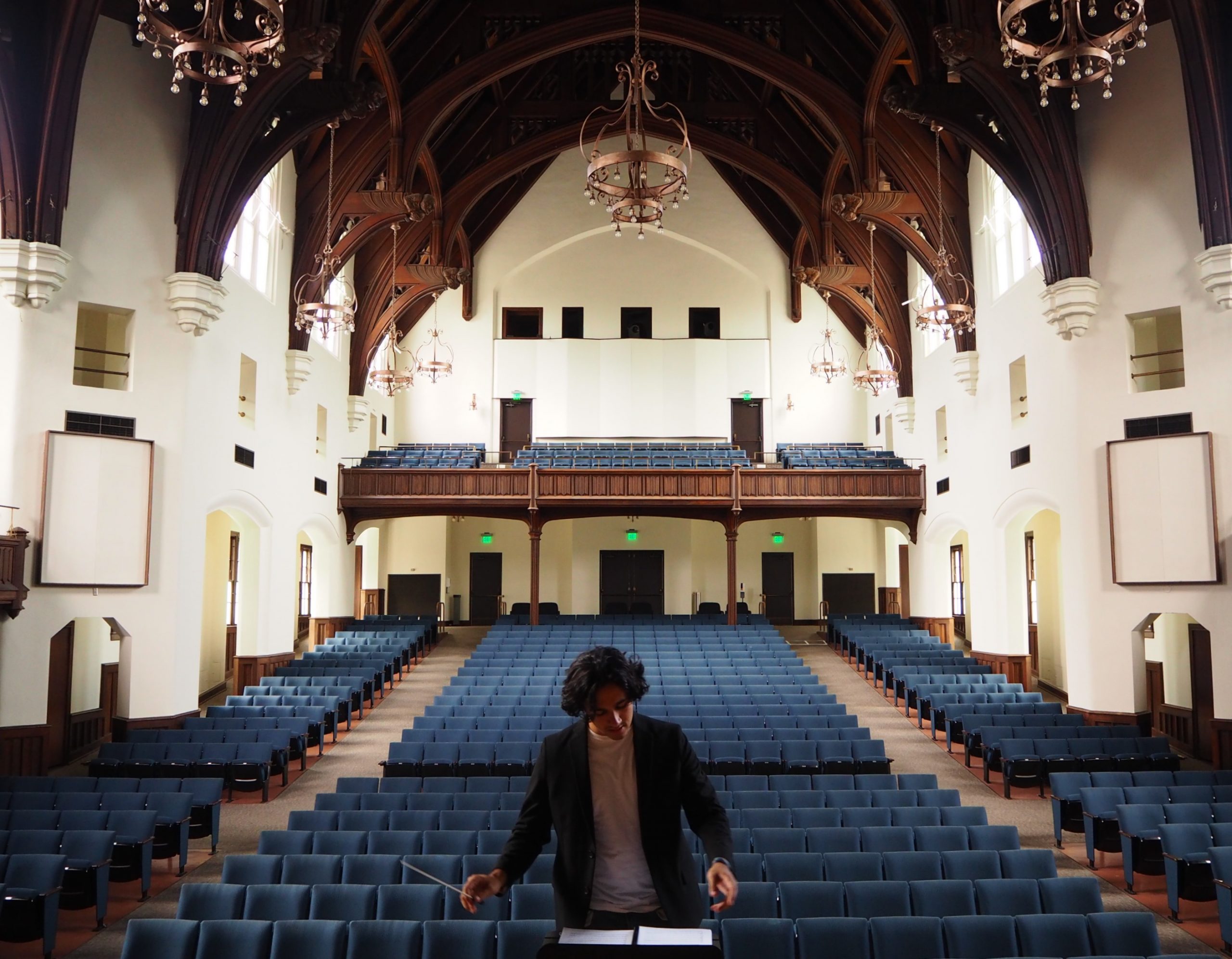
Today we’d like to introduce you to Axel Castro
Hi Axel, we’d love for you to start by introducing yourself.
I love this question because I think about it all the time.
I was always good at music and I was always good at math and science. I chose to go down the math and science road because I had a higher chance for success in my future career. I prepared everything starting in high school for Neuroscience and Biomedical Engineering. Still, I owe a lot to the Lake Nona High School Chorus director Justin Chase for encouraging me to pursue my musical passion. He gave me my first taste of film music when he invited me to a seminar where A-list composer Michael Giacchino would speak about his experiences as a Film Composer. I had never really considered this path as a musician but after that hour or two of hearing Michael speak, I fell in love.
Despite this, I remained firm on my math and science journey and got into The University of Florida for Biomedical Engineering. Everything was awesome about this except it felt extremely weird to not have music be a big part of my life as it had been for the previous 7 years. As I kept moving through the BME degree, I felt a constant pull back to music and eventually, I caved. I switched majors and committed to Film Scoring.
Unfortunately, UF does not have a very strong Film Scoring program, and I felt that to truly take the leap of faith I had to go somewhere that understood what it means to be a film composer, and first on the list was Berklee College of Music in Boston. So after extensive deliberation with my extremely supportive parents and three years of study at UF, I came to the conclusion that I may fail at Film Scoring, but I may also fail at doing something that is not truly what calls me, so I might as well go for it.
Having come to this conclusion, I applied, was accepted, and have since scored 10 short films, I was just selected in the top 20 out of 200 Berklee Film Scoring students to be considered to write and record a piece for Redbull, had a premiere at Carnegie Hall, and hope to be working with Disney and Netflix on two projects that I, unfortunately, cannot share at the moment!
It has been difficult don’t get me wrong, but I wouldn’t change a thing. I am not the same person I was 3 years ago and it is all thanks to just trusting my gut and going for it!
Alright, so let’s dig a little deeper into the story – has it been an easy path overall and if not, what were the challenges you’ve had to overcome?
I would say overall it has been a fairly smooth road all things considered. A lot of the struggle was mental.
A big portion of my energy was dedicated to staying confident in my ability, and not letting any rejection or fear of failure get in the way of what could be. This is not always possible, but you do always have the choice to let these things get to you if you don’t stand your ground.
A few examples to give you an idea:
I applied to Berklee and got in. However, I also applied to NYU, Juilliard, and the University of Southern California and was rejected from all three.
I have scored 10 short films. On the other hand, I expressed interest in or applied to well over 150 films from students and directors across the country. I was considered for no more than 15 of them, and I got 10. That is, at best, a 6% success rate.
I currently am interning for the wonderful composer Esin Aydıngöz known for her recent work on Netflix’s “Wednesday” where she contributed with the well known Paint it Black arrangement for Cello. I have one internship. I applied to 32. Compared to some engineering or medical students, this may not sound like a lot, but I encourage you to go on Linkedin and find “Film Scoring Internships”. If you see any send them my way!
While these experiences may not sound too intense or extreme, because they’re not, a lot of the struggle falls in those spaces you can’t really see from the outside. Looking back it seems obvious and somewhat insignificant, even to me, but it takes a while to start seeing those little nuggets of success. To try to combat this long wait time, in my experience, exhausting every option three or four times over is the best way to keep moving forward.
Can you tell our readers more about what you do and what you think sets you apart from others?
I love film music. I live and breathe film scores and I love contributing to films with my music.
I would say something that the directors I have worked with would all hopefully agree on is that I am incredibly passionate about what I do, and I care about making something worthwhile that tells a meaningful story. Additionally, I love interviewing for directors because I get to hear what makes each person tick, and how all of their life experiences have contributed to the film that they are entrusting me with.
I find this incredibly fascinating because one thing I would say all the directors I worked with have in common is that their films, in one way or another, are a reflection of their beliefs and ideologies about life. You don’t really get to see this in other career paths. Certainly not in math or science.
I think what I am most proud of and what sets me apart might be the same thing. I work extremely hard and with very high precision. In the three years that I have been in Boston, I have accomplished what I set out to do tenfold. I hoped to leave Berklee with 5 short films, and as I mentioned before, I have been in contact with Redbull, Disney, and Netflix in addition to scoring 10 short films and working an active internship. I think that while some luck is always involved, it is no coincidence that all of these opportunities have come my way!
What has been the most important lesson you’ve learned along your journey?
The most important lesson for me has been knowing that everyone has something that worries them and makes them feel doubt or fear.
This has been critical in my pursuit of Film Scoring in particular because, with music, almost any choice can be justified depending on who you are talking to. This means that yes, you may get lucky and surround yourself with people who happen to line up with your musical and compositional taste. However, more likely than not, you will find that most of the people who are around you have a very different musical view than you do, and can even put your compositions and musical ideas down to bring theirs up.
As a result of this, you may get exhausted from having to justify your piece or defend yourself against those who might think. your music is no good. This is a recipe for disaster and is likely to end with you ending your musical pursuits.
I have found that for me, the most effective way around this is to understand that everyone is feeling the same worry, insecurity, and fear that you are. The difference is that those who are unable to deal with those feelings react by insulting or framing your music in a bad light. This shift in perspective has changed how I go about writing music and how I react to feedback from friends or professors.
Contact Info:
- Website: https://play.reelcrafter.com/axelcastro/reel
- Instagram: https://www.instagram.com/axelcastro_music?igsh=MXQzeHM5dHAxdTZ1&utm_source=qr
- LinkedIn: https://www.linkedin.com/in/axel-castro-24451016a/