


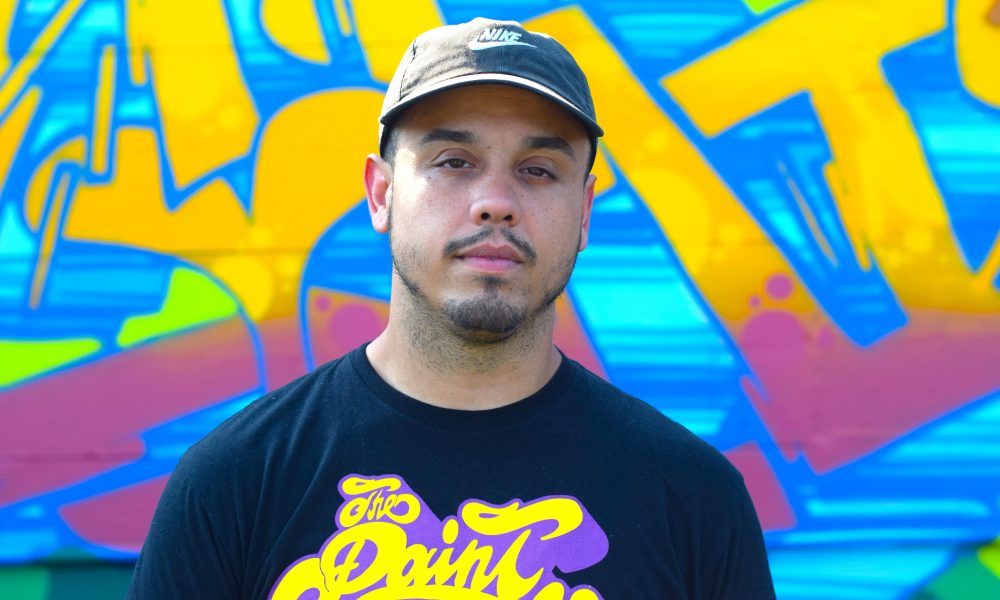
Today we’d like to introduce you to Ron Rivera.
Hi Ron, we’re thrilled to have a chance to learn your story today. So, before we get into specifics, maybe you can briefly walk us through how you got to where you are today.
I first fell in love with art through graffiti. I was about five years old, living in New York. And I remember growing up in the Bronx in 93-94; my mom would walk me to school every morning, and on my way to school, I saw so much graffiti on almost every part I could see. And even at the school, the handball court walls would have different full-blown productions, so I was submerged in it at a young age. And I gravitated toward it. The colors and the characters attracted me to that type of art.
And also, it was the only real type of art I would see in my everyday life. Fast forward a few years later, during a move to Virginia, I found an old little graph book my dad used as a sketchbook. And when I open it up, it’s got graffiti from when he was a kid, and he would dabble in graffiti. So from there, my interest went from just admiring to ok, let me try to do this. And I would use his little book to practice and get ideas. And from that point on, I was addicted. All I did was look, do, research, and find all and anything I could on the graffiti culture. And I was practicing as much as I could. I did it all through my high school years. That’s when I started painting.
I met some older writers while living in Virginia, and they took me under their wing and helped me develop as a writer. And I just kept with it practicing even more; then the internet played a role, and I could see everything from all over the world, and that was a game changer in itself. But when I moved to Florida after high school, my graffiti took off. I started to paint a lot more. I met with some writers out in Melbourne who later became my crew mates and best friends, and that’s when I started having gallery shows and going to Miami and painting big walls, shows, museums, books, magazines, music videos, etc.
Can you talk to us about the challenges and lessons you’ve learned? Looking back, would you say it’s been easy or smooth in retrospect?
My biggest struggle with my art was breaking out of that stigma that all graffiti is ugly and gang-related.
So I always try to make my stuff legible and colorful and add things to it that people understand and can relate to, whether it’s a color scheme or designs like animal prints, but still, to this day, there are some folks that graffiti brings all the bad stuff.
Appreciate you sharing that. What else should we know about what you do?
I like to consider myself a graffiti writer. I like to bend letters in ways other people can’t imagine. I love the idea of doing something really simple, like the font on a keyboard, or something complex, like graffiti letters or cursive. If you look around you, everything has graffiti influence or typography.
Letters and words are important, so I like to make mine look cool. I believe my proudest moment or at least one of them. It was when I was featured in the Miami graffiti book. Seeing my art published with me in it was such a big deal. And then, traveling to Los Angeles to have a book release party was so crazy to me. I felt good at the time, like I made it.
What’s next?
In the future, I would like to do more big projects. I want to create a book that showcases my art. But I want to do it in a way that’s different from just a book with pictures.
I want to develop something cool and new. I would also like to paint more graffiti events. I enjoy the feeling of being around other writers doing their thing while everyone is just having a good time painting
Contact Info:
- Instagram: @this.1


 Image Credits
@publicartnation