


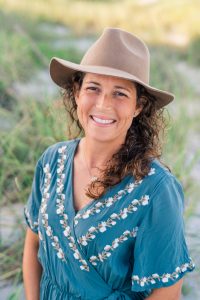
Today we’d like to introduce you to Kristen Swayze.
Hi Kristen, it’s an honor to have you on the platform. Thanks for taking the time to share your story with us – to start maybe you can share some of your backstory with our readers?
Back in 2017 my husband started hinting at the idea of acquiring some bees to help in pollinating a few fruit trees we had planted on a piece of property we owned. I politely asked to wait until after the arrival of our newest addition and also after we made a decision if we were going to build and move to the property or look elsewhere. About a week later he came home from work, very proud of himself, and told me we were now proud parents of a few thousand bees!
Prior to this I knew the basics on how important bees were to our lives and somehow they made honey, but that was the extent of it. When the bees arrived I was intent on this being a husband project and not something I needed to be involved with but that all very quickly changed. The first time I went with him to check in on the ladies and he opened up the lid on the hive I was blown away by the energy that this colony of bees created. Then as he started removing frames of bees and I could see the pollen they had collected, the nectar that was being ripened into honey, the queen meticulously laying eggs and all of the inner workings of the colony it was hard not to get sucked in.
After a few trips to the bees I started doing a little research on their importance and came across a statistic that stated that one out of every four bites of food we eat happens because of pollination from honey bees. That was a turning point in my lack of enthusiasm for this new project my husband created for us! Our first honey harvest also had a rather large impact in my outlook for them!
One colony quickly grew to three, which grew to five and currently we are working with around 60 different colonies in two different locations and have started offering backyard beekeeping services. We sell our honey directly to the consumer through local deliveries and pickups, truly a hive to home process! In addition to our honey we also use the remaining beeswax to make small batch products so nothing goes to waste – lotion bars, lip balms, and wood conditioners to name a few. We also love collaborating with other local businesses to create specialty products made with or for our honey to pair in our gift boxes and bags.
Our main apiary (a collection of beehives) in Micco is the home base for our Seasonal Bees. These ladies travel throughout Brevard County to visit different flower blooms to create the different varieties of honey. Just after the new year we loaded them up on our trailer and nestled them into a mango grove in Merritt Island where they produced a very fruit forward mango honey that is out of this world! Later this summer they will head to south Melbourne Beach along the Indian River Lagoon and visit the blooming mangroves for a buttery, rich mangrove honey. In our hometown of Melbourne Beach we have our second apiary just steps away from the beach. These ladies thrive on the local blooms year round produce our seasonal Beachside Honey varieties.
We have three amazing helpers who suit up and work through the colonies alongside us, and have become master blueberry pickers with our latest addition to the property! Along with our bees we have around 80 mango trees and have just added 60 blueberry bushes. We love having this company be a reflection of our family (the LKC in our name comes from our initials). It is a constantly evolving process and fits us perfectly!
Would you say it’s been a smooth road, and if not what are some of the biggest challenges you’ve faced along the way?
It has been a very interesting experience. Learning how to work within the colonies is a constantly evolving process. The art of keeping bees has been in practice for thousands of years, but there is still so much we don’t know about the bees themselves. Since 2006 colony loss has been a major concern of beekeepers worldwide and is still a factor today. We are constantly expanding our knowledge of best practices and latest research to keep our bees healthy and thriving.
The honey business is also an interesting one to be mixed into. There are very little regulations on what constitutes a honey product and many of the jars of honey sitting on grocery store shelves have been adulterated with corn syrup or other sugars. Educating our customers on the difference between mass produced, imported honey and boutique, small batch, beekeeper to consumer honey has opened the conversation.
In one of the talks I give I dive into the different seasons of honey we sell and what created the different flavor profiles of each. Many people are under the assumption that honey, is honey, is honey and that could not be further from the truth. The flavor, texture and smell of the honey is driven what the bees are collecting, the weather, time of year and location. Our two apiaries are separated by the Indian River Lagoon. One is in Melbourne Beach just steps away from the beach and the other is in Micco, just out the outside boarder of the Sebastian State Buffer Preserve. Just about five miles separate the two but in the spring the two sets of colonies will produce two completely different flavors of honey, even when they are harvested at the same time. This idea that honey is not just a one size fits all and is more on the level of wine with its complex makeups, variables and varieties is so neat to share.
As you know, we’re big fans of LKC Honey. For our readers who might not be as familiar what can you tell them about the brand?
When we made the decision to expand from hobby beekeepers to full on honey production there were a few things that we knew for certain. We treat all of our bees like queens. Our bees are handled with the utmost care and respect. We strive to produce a quality product over quantity. We never bulk order from a honey distributer and repackage under our label. Our honey is always 100% raw from our hives.
Having our children interested and active in the work in the apiary is beyond exciting. Watching them learn and respect these amazing creatures in this environment is priceless. We love seeing them suit up and to get in the hives and listen to them talk to the bees!
Currently our honey is only available direct from our hives to our customers. If we are out of your area it is still easy to get high quality, raw, direct from the hive honey. Search the web or Facebook for a local bee club and they will help point you in the right direction of a local beekeeper! We promise that once you have honey straight from a hive it will be hard to grab the plastic honey bear off the shelf!
Is there anything else you’d like to share with our readers?
Everyone asks how they can help save the bees. While we are in the business of selling honey we are also intently driven to help all pollinators, not just our honey bees. We have partnered with a local native landscaper to create Pollinator Packs – honey paired with native plants that are easy to maintain and will help all pollinators have a leg up! Buying your honey from a local beekeeper, planting natives in your yard, being very mindful of what you are using as pesticides on your garden are very quick and easy ways to help out the pollinators. Want to go a step further? Reach out to your local bee club and add a colony of bees to your backyard!
Contact Info:
- Email: lkchoney@gmail.com
- Website: www.lkchoney.com
- Instagram: https://www.instagram.com/lkchoney/
- Facebook: https://www.facebook.com/LKCHoney
- Youtube: https://www.youtube.com/channel/UCvC1W1OSTqDsAIm_I8BWMgQ
- Other: https://lkc-honey.square.site/


 Image Credits
Lisa Marshall Photography Brevards Image Photography