



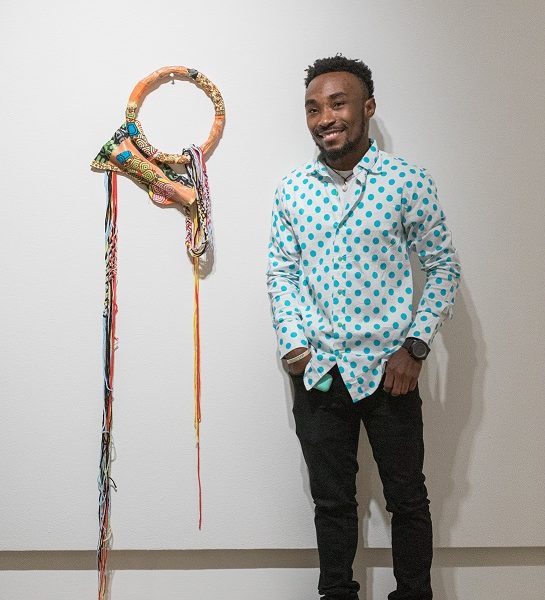
Today we’d like to introduce you to Eugene Ofori Agyei.
Hi Eugene, please kick things off for us with an introduction to yourself and your story.
Eugene Ofori Agyei (1993) is my name and I am a ceramic sculptural, fiber and installation artist and an educator originally from Ghana living in Gainesville, Florida. I graduated from Kwame Nkrumah University of Science and Technology in Kumasi, Ghana with a BA in Industrial Art, majoring in Ceramics in 2018. Prior to my MFA at the University of Florida, I was assigned as teaching and research assistant in the same school where I received my BA for one year. I have had awards to my credit and recently the awardee of the Pathways 2022: The Carlos Malamud Prize for emerging artists in Florida. I have shown my work nationally and international and my upcoming solo exhibitions will be at Art Center Sarasota (FL) in the Spring of 2023 and Rollins Museum of Art (FL) in the summer of 2023.
Before going to college, I was a graphic designer who never thought of manipulating clay. I was curious about the roadside artists in Ghana working with clay and amused and surprised to see people managing to make something out of nothing. I recall feeling nervous that their art could break. My serious interest in ceramic art took root after I gained admission to Kwame Nkrumah University of Science and Technology (KNUST). Though I was living in the city, I was still eating from a traditional ceramic bowl called a grinding bowl locally known as “apotowa.” Even though I entered college as a graphic designer when I ended up taking a clay class and the feel of the clay made me realize how satisfying working in clay was. The experience of handling the clay was kind of therapy. All my questions were answered. Clay claimed me, and I also started making something out of nothing.
Growing up, I began to realize I had big expectations placed on me as the elder child in the family. All eyes were on me, and I had big shoes to fill. My mother wanted me to have success in fields like science, accounting, and building technology, etc.
I remember she asked me during my graduation in 2018, “Eugene! what do you want to do with your life?” I told her I wanted to be an artist. My inner goal was out! I wanted to become a professor, professional and contemporary artist and I met Professor Jeannie Hulen from University of Arkansas who came to Ghana as a Fulbright scholar. She made me know it is possible to get into a school in the US. I did my research with her help, I applied and got accepted into 6 schools in the US.
I’m sure you wouldn’t say it’s been obstacle free, but so far would you say the journey has been a fairly smooth road?
No, it hasn’t been a smooth road especially when I accepted to study art in college. My mother did not like the idea, so I felt I was alone for some time. I kept on persisting with my dream and now, she is a big fan of my work.
Thanks for sharing that. So, maybe next you can tell us a bit more about your work?
I am known as a contemporary artist making ceramic sculptural, fiber, and installation art. My artistic practice is informed by my position as a Ghanaian currently living in the US. I grew up having two mothers, and out of my family home, I am known as an Akan, which is the ethnic group to which I belong. When I am located outside Ghana and in another African country, I am known as a Ghanaian. When placed outside Africa, in the United States which is my first foreign country I have visited, I am known as an African. This is how my identity connects to space and place being it local or foreign.
My work encompasses the architectural, geographical, cultural, and social spaces encountered as people of the diaspora. Intrinsic to my work is the love of materials which are utilized to create complex visual and tactile layers as well as layered associations and meanings. I use clay to communicate my challenges of occupying these two worlds as form and shroud them in bright-colored African batik fabric, yarn, and familiar materials found in my daily life to reflect my identity. Batik fabric is originally manufactured in Indonesia and have them printed in Africa of which the yarns originally come from China. Its complex material history symbolizes cultural hybridity.
I explore techniques revolving around the deconstruction of the standard of dependence on glazes as the sole ceramic finishing technique. As is the case in much of traditional African art, I disregard (Western) aesthetic expectations, but the work instead being concept driven. I characterized a visual scenery, commanding the experience and engagement of the viewer in my work and explore the complexities of double consciousness in my hybrid identity as way of addressing beauty, culture, and migration.
Is there anyone you’d like to thank or give credit to?
Professor Jeannie Hulen was a Fulbright scholar in Ghana who showed me the way of pursuing my artistic career by introducing me to universities and other art opportunities in the US when she met me in Ghana in 2019. She is a mentor and has played a bigger role in my artistic career. Professor Anna Calluori Holcombe is also a great mentor who has impacted positively in my creative success when I moved to the US. The School of Art and Art History faculty at University of Florida has been supportive in my studio practice and Donte K. Hayes is a wonderful black artist that I look up to.
Contact Info:
- Website: www.eugeneagyeiarts.com
- Instagram: www.instagram.com/eugeneagyeiarts/
- Facebook: https://www.facebook.com/agyei.ofori


Image Credits
Laney Mae