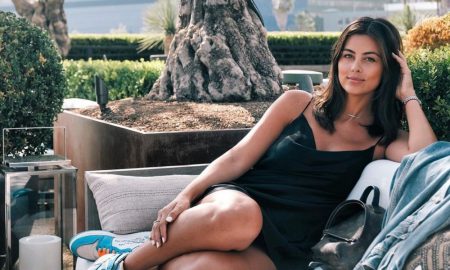



Today we’d like to introduce you to Nicole Benton.
Hi Nicole, it’s an honor to have you on the platform. Thanks for taking the time to share your story with us – to start maybe you can share some of your backstory with our readers?
I am a black woman, born and raised in Chicago, Illinois, a graduate of Clark Atlanta University, a Historically Black University, where I studied Communication. After graduating from Clark Atlanta, I moved to Central Florida and after taking time off to have my two children, I went back to school to receive my Master’s degree in Mental Health Counseling. After going through my formal clinical training, I was finally able to open my own private practice three years ago, where I specialize in working with black women, empowering them to be able to discover the best version of themselves. My dedication to this demographic of women led to my practice being recognized as an outstanding black-owned business award by the NAACP and BeyGood, the charity founded by Beyonce Knowles-Carter.
Over the last few years, of course I’ve been tasked with ensuring that I help my clients achieve optimal wellness. However, in listening to my clients, I also discovered that many of the things that were keeping them stuck or unwell were issues that exist more on a macro level and that many of these things could not solely be handled through clinical sense but must be inclusive of a social justice lense. Understanding how my work can be expanded outside of the clinical treatment room marked the beginning of my journey to ending up in the civic engagement space.
I initially ended up volunteering with a black women’s public policy institute, ascending to a leadership role as the Chief Ambassador of their Young Ambassador’s Program. In that role, I worked with the Congressional Black Caucus during their Annual Leadership Conference and was able to gain a more in-depth perspective on what it means to be civically engaged and passionate about working for fair and equitable voting rights. Voting rights is an issue that is extremely important to me for a few reasons, both personally and professionally. As a mental health clinician, I recognize and have witnessed firsthand how voter disenfranchisement can negatively affect mental health. This became even more apparent particularly during the time leading up to the 2020 election, as fear, anxiety and hopelessness were common themes that I witnessed in my office. Being that I work with 100% people of color in my practice, I was pretty disheartened to know that mental health issues were on the rise in my community, particularly centered around voter/election fears and voter disenfranchisement. I then decided that I wanted to be a part of continuing to reduce those barriers that have historically stopped folks that look like us from being able to exercise their full rights. Although I don’t come from a traditionally political background like most of my colleagues here, I knew that I would still be able to make a difference in this space. That’s how I ended up here at Equal Ground!
Equal Ground is a black led, community-centered political organization with the aim of engaging, educating and empowering black voters along the i-4 corridor. Our core counties include Orange, Seminole, Pinellas and Volusia counties, yet we also engage in efforts across the entire state. Equal Ground works to increase and enhance black political participation and power in underrepresented communities. We fight for the issues we believe in, including fair elections, equitable access to healthcare, and social justice.
Additionally, we recognize the importance of community-based power, so we work to build relationships and partnerships in a continued effort to build strong coalitions throughout our core counties. These relationships are managed by our County Managers, which is the role that I currently serve in, in Seminole County.
Would you say it’s been a smooth road, and if not what are some of the biggest challenges you’ve faced along the way?
This field definitely has its challenges, but what industry doesn’t? We face some challenges in that this work can be extremely grueling at times, not necessarily the actual work itself, but more so the constant realization that there are always certain systems in place that we must continue to work to dismantle before any long-lasting change occurs. As an organization, we do our part to continue our mission of engaging and educating black voters. Yet, due to the specific nature of our work and the continued systems in place to disenfranchise voters, we recognize that many of the people in our communities are weary. They are weary of the same news cycles, weary of continuing to be faced with systemic oppression and inequitable treatment, and weary of feeling like their voices and votes do not matter. As leaders in our field, we readily recognize the importance of thinking outside of the typical box and diligently work to continue to find innovative approaches and solutions to not only educating voters but to building meaningful relationships with community members and leaving an indelible impact on the communities that we serve, despite the challenges that we may face.
Appreciate you sharing that. What else should we know about what you do?
I currently serve as the Seminole County Manager for Equal Ground Education Fund. In this role, I work to coalition build and maintain relationships with our community partners throughout Seminole County. A critical piece to building these relationships is to ensure that we demonstrate what it looks like to truly be accomplices in this fight for social justice. We often hear of the importance of being allies, but being an accomplice means that we are actively engaged and have boots on the ground to do the work. It is not just solely about our mission as an individual organization but working for the overall greater good of our communities. So while we are primarily a voter education-based organization, you will also see us helping out at partner food distributions, community clean-ups or other community events throughout our four counties.
In doing this work, I make sure that I listen to the community residents and ask what would help you to become more civically engaged in your local elections and in your community? I’ve gotten a variety of answers when asking this question, but the one thing that I consistently heard was a desire to receive help or assistance. I’ve also learned that food scarcity is a pertinent issue in some of the communities that we serve, and so I said to myself, how can I ensure that the community’s needs are being met while also engaging them and educating them on voting rights?
The answer was creating what became known as the Food & Justice Tour.
This tour, a part of my work that I am most proud of, was created by me in partnership with a local non-profit, The Picnic Project. I created it as a means to continue our efforts of engaging the rising American electorate through civic engagement activities with a goal to build and expand current capacity and political power in Black communities. It is a year-long program that will be held in different locations throughout Seminole County, and each stop will feature a cookout, music and live conversation on how we can continue to expand our political engagement and capacity in our community. As an organization, we host a ton of trainings and more formal ways for emerging leaders to become more engaged in the political process, however, we want to be an inclusive organization who engages those who may not engage in such formal training but still desire their voices to be heard. The Food and Justice Tour provides food, free of charge to anyone who joins, and also gives residents the opportunity to ask questions about the political process, get further educated on what is at stake during these upcoming elections, learn about ballot initiatives, and find out how they can get more involved locally or on a statewide level. Most importantly, it’s a safe space for black joy!
I am very excited to continue this effort with our amazing partners and watch it continue to grow even beyond Seminole County.
What sort of changes are you expecting over the next 5-10 years?
As a community organizer, our work is largely dictated by the issues and causes we represent. When public policy doesn’t address the needs of our community, we must recommit ourselves. Since the 2016 election, we have seen a way of conservatism which has sought to disenfranchise millions of people throughout our country. Those policies and beliefs didn’t leave just because there was a transition of power. I predict that over the next ten years, we. will have to double our efforts to fight back against oppressive legislation which seeks to disenfranchise communities of color. We saw that in Florida with the implementation of legislation such as S.B.90 and H.B.1. Fortunately, one of the bright spots of the pandemic is it taught us how to be creative and utilize technology to accomplish our work. It is my thought process that as we move forward, technology will play a major role in how we work.
Contact Info:
- Email: nicole@equal-ground.com
- Website: www.equal-ground.com
- Instagram: @equalgroundfl


 Image Credits
Alicia Bromfield