



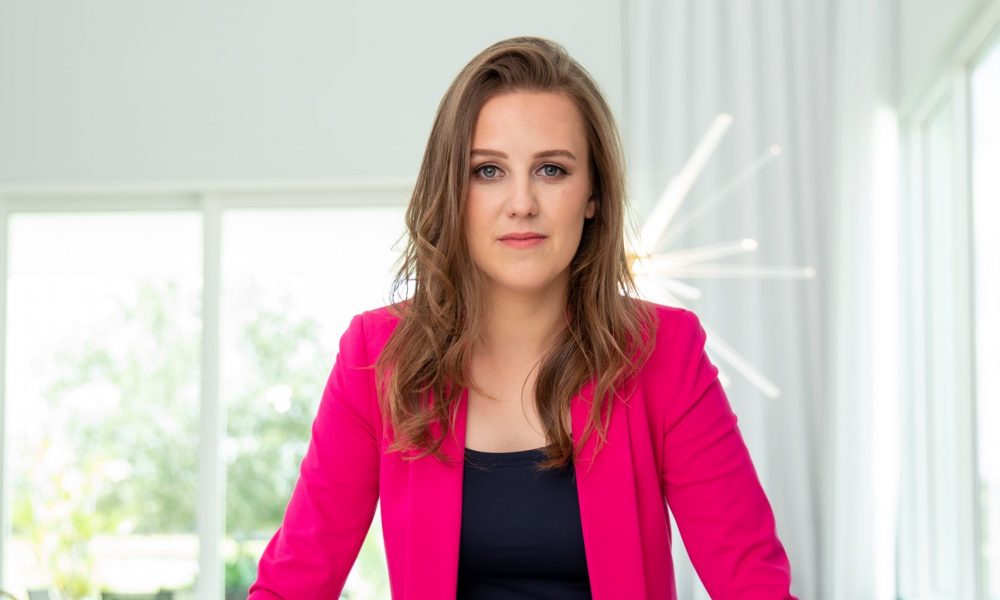
Today we’d like to introduce you to Anna Cheniuntai.
Anna, we appreciate you taking the time to share your story with us today. Where does your story begin?
I always wanted to be an entrepreneur. I decided to study Space Physics as a university student because it was something fundamental, very interesting, and inspiring.
One year before graduation, I met my future Apis Cor co-founder, Nick. At that time he had his own business building industrial machinery robots like CNC milling routers and metal cutting machines. Factories would come to Nick and ask him to build machines to do specific tasks because they could not find a solution on the market and Nick would build custom machines to meet their requirements. I joined him and started helping with the operational part of the business and learned a lot about heavy CNC machinery.
Everything changed when we secured a massive contract to manufacture and deploy the ground navigation system for visitors of the Olympic Games in 2014.
Nick and I were literally responsible for millions of visitors finding their way around the Olympic Games and not getting lost. We had to develop the routes, and design, fabricate and deploy all of the signage. It was an extremely hard project to complete within a short period of time. To make matters worse, construction sites where we were to deploy the signs were not completed on time.
Fortunately, we successfully delivered and not only got our first big paycheck (the total value of the contract was about $5m), we also learned how outdated the construction industry was. This inspired us to invest our time and money into changing the way houses are built.
We launched Apis Cor, and I officially became the entrepreneur I always wanted to be.
Studying Space Physics gave me the knowledge I need to lead Apis Cor into the future.
Alright, so let’s dig a little deeper into the story – has it been an easy path overall and if not, what were the challenges you’ve had to overcome?
As the CEO of a startup, I was challenged to do things I did not have enough experience with such as fundraising. And we needed to raise money. Everything was even harder because of COVID that just started at that time. It took a lot of effort to constantly change the strategy, learn from my mistakes, adapt quickly and stay focused. I had about 150 online meetings and kept moving after many “NOs” in a row. Just imagine, this young female founder running a hardware-tech construction startup and raising money from investors over Zoom – it was challenging to say the least!
You don’t know what you are capable of until you try. I raised the first $ 500K dollars within about four months.
In my job, fundraising never stops. We are scaling our business for the construction trades, producing the components of our mobile 3D printing technology. We are going to market with the Apis Cor system to build more houses and eventually help narrow the gap for affordable housing. To support our growth we are qualified by the SEC to raise funds under the Regulation A+ offering. Everyone – both accredited and non-accredited investors – can participate in building a better future with a minimum investment of $1,000.
As you know, we’re big fans of Apis Cor. For our readers who might not be as familiar what can you tell them about the brand?
Our company, Apis Cor, 3D prints full-scale houses.
Based on our Olympics experience, we realized that the construction industry desperately needed automation and new tools to increase productivity, build homes faster and more affordably. We knew that if you want to really innovate with robotics for printing houses, the equipment had to be mobile, transportable and easy to operate. Nick invented unique 3D printing robots operated by joy sticks with true mobility and portability that allows to 3D print houses of any sq.footage directly on site. This feature is unmatched today by other companies but it is something that is needed to make the technology scalable.
There are three key components to the Apis Cor system: a 3D printer called Frank, a mixing and pumping unit called Gary and a material delivery truck called Mary. A standard pickup truck with a flatbed trailer can haul Frank and Gary to a construction site, where an operator uses a joystick to drive them off the truck and to the building’s foundation. Together, they can print the walls of a house or other buildings using a concrete-like strong and durable mortar.
3D printing opens the horizons for alternative and eco-friendly materials. For example, we have been developing the geopolymer 3D print material. They are called “geopolymers” because the raw materials used for their production are mainly minerals of geological origin such as calcined clays, coal fly ashes, and industry by-products. This material is stronger and more fire-resistant than traditional concrete. But most important, is that this material can be completely cement-free.
Imagine millions of homes being built without cement but still stronger than concrete homes.
3D printing also opens up new building design freedoms. It is now possible to build curved walls, which was very expensive or even impossible with traditional materials. Curved walls can be structurally stronger for flood and wind resistance, curved shapes are better at load distribution than straight elements.
We have proven our technology on numerous continents.
In fact, Apis Cor holds the Guinness Book of World Records for the world’s largest 3D printed building – a two-story structure in Dubai. In 2021, we 3D printed two buildings in the United States. One is a residential building in Missouri and the other is the first fully-permitted 3D-printed commercial building in Boca Chica, Texas.
Apis Cor also won top awards at NASA’s 3D printed habitat challenge, validating that the technology we are developing can be someday used to build shelters on the Moon and Mars.
Are there any apps, books, podcasts, blogs or other resources you think our readers should check out?
I do like documentaries on Netflix, anything from history, ocean expeditions, aircraft manufacturing to documentaries about Taylor Swift and Madonna. Netflix produces high-quality content. It helps me to learn new things and keep getting inspired. For work, youtube is one of the main sources I use – I always need to explore new tools for business as well as technical things like construction technologies and material science.
One of my most favorite books is “Trilogy of Desire: The Financier, The Titan, The Stoic” by Theodore Dreiser. It had a deep impression on me. I read it when I was studying at university and was so immersed, I couldn’t put it down! The main character Frank showed how you can achieve literally anything and make your dreams come true. If you are a smart, strategic thinker, you can withstand huge challenges, and if you are brave and fully faithful/committed to your beliefs, you will be successful.
Contact Info:
- Email: general@apis-cor.com
- Website: https://www.apis-cor.com/
- Instagram: https://www.instagram.com/annie_cch/?hl=en
- Twitter: https://twitter.com/acheniuntai
- Youtube: https://www.youtube.com/channel/UCtjcSOYk2QXngTzbB5P1p8A


Image Credits
Apis Cor